Table or museum
The Napoleon Cave or Maison Bonaparte?
Two ways to meet Napoleon on the same old-town street in Ajaccio: a film and a Corsican meal, or the house where he was born. How they differ, and how to pair them on a single day.
Find my Napoleon Cave session ↗Quick answer
Choose the Napoleon Cave for a relaxed hour of Napoleon's whole life on screen, in your language, with a Corsican meal and drinks on the table. Choose the Maison Bonaparte for the house itself, where the Bonaparte family lived for generations and Napoleon was born. Both sit on Rue Saint-Charles, so with half a day in Ajaccio the best answer is to do the museum first and the meal after.
Table or museum, side by side
| The Napoleon Cave | Maison Bonaparte | |
|---|---|---|
| What it is | A one-hour session: Napoleon's life on several screens with a Corsican meal | The Bonaparte family home, a national museum since 1967 |
| Street | 4 Rue Saint-Charles | Rue Saint-Charles |
| How the story is told | On screen, from childhood to his peak | Through the house he was born in |
| Food and drink | Muscat aperitif, spuntinu, a drink of your choice, coffee | A museum visit, so plan your meal around it |
| Languages | Audio in English, French, German, Italian, Spanish | Check the museum's own information |
| Best for | Families, mixed-language groups, a sit-down break | Seeing the rooms and the house's long history |
Two good answers on one street
Napoleon Bonaparte was born in Ajaccio in 1769, and the town has never let anyone forget it. Of all the places that carry his name, two on Rue Saint-Charles answer the same wish in different ways. The Maison Bonaparte is the family house, now a national museum. The Napoleon Cave, at number 4 on the same street, is a one-hour session in which his life is projected on several screens while you share a Corsican meal. Neither replaces the other. One gives you the real place; the other gives you the whole story and lunch. Your choice comes down to time, appetite, the ages of the people with you and how much reading you want to do on holiday. If you have half a day free in the old town, the simplest plan is to visit both, and the sections below show how.
The house on Rue Saint-Charles
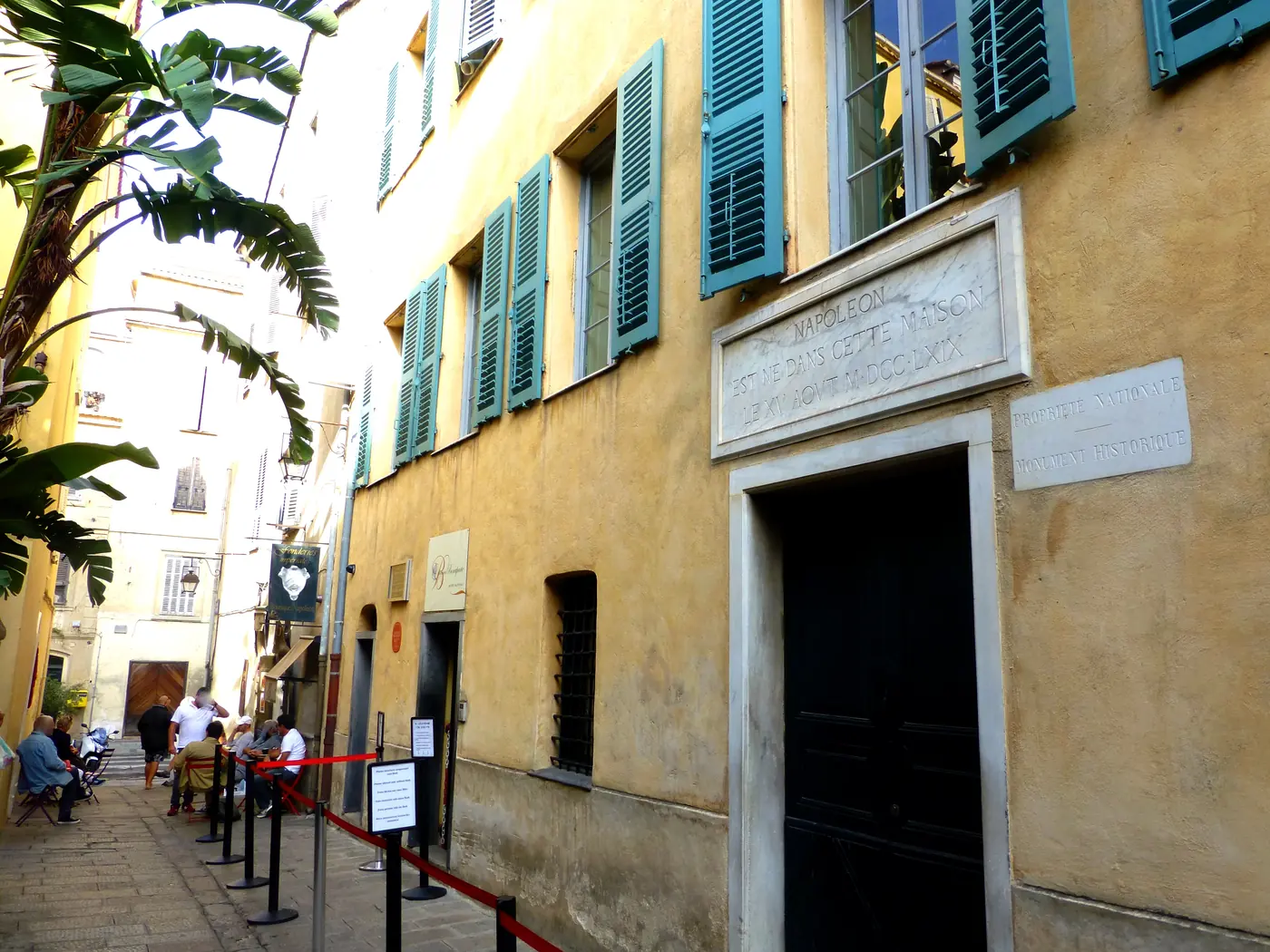
Wikipedia describes the Maison Bonaparte, Casa Buonaparte in Corsican and Italian, as the ancestral home of the Bonaparte family on Rue Saint-Charles in Ajaccio. Members of the family owned it almost without a break from 1682 to 1923. Napoleon's great-great-grandfather Giuseppe Buonaparte moved in first, when the house was still divided between several families; after he married Maria Colonna di Bozzi, who owned part of it, he bought the rest. Carlo Buonaparte, Napoleon's father, later enlarged and redecorated it after his marriage to Maria Letizia Ramolino, and all of their children except Joseph were born there. The Ajaccio article on Wikipedia calls it a huge four-storey home in town, which matches what you see from the street: a tall façade on a narrow lane, with a marble plaque above the door recording Napoleon's birth.
What the house went through
The house did not sit quietly through history. In 1793, eight years after Carlo's death, the family fell out with the Corsican leader Pasquale Paoli and had to flee to the French mainland, and Paoli's followers looted and burned much of the house. British officers were billeted there after Admiral Samuel Hood arrived. When British troops left Corsica, the Bonapartes came back in 1797 and repaired the house with money from the Directory. Later it passed through several hands in the family; in 1852 Joseph's daughter Zénaïde gave it to Napoleon III and Empress Eugénie, who refurbished and enlarged it to mark the hundredth anniversary of Napoleon's birth. Prince Victor Napoleon eventually gave it to the French state, and in 1967 it became a museum and was declared a national museum. All of that is on Wikipedia, and it is exactly the kind of layered story a house tells better than a screen.
The Napoleon Cave in brief
The Napoleon Cave works the other way round. Instead of rooms, it gives you narrative. The Viator listing for the complete package describes a cultural session retracing the life of Napoleon Bonaparte from his childhood to his peak, projected on several screens with a multi-language audio system, while you taste spuntinu, which the listing calls the traditional Corsican meal. A welcome aperitif of Corsican muscat, a drink of your choice during the meal and a coffee are all part of the package. The session lasts about an hour, it runs at lunch and at dinner, and the venue is La Grotte Napoléon at 4 Rue Saint-Charles. Guests rate it 4.7 out of 5. You can cancel free of charge until a day before, and on 28 November 2026 the product page offered reserve now, pay later.
How each tells the story
The museum's strength is presence. You are inside the walls where the family lived, on the street where Napoleon grew up, and the building itself carries the episodes in its history: the flight of 1793, the looting, the repairs, the imperial refurbishment. The Napoleon Cave's strength is sweep. In one sitting it runs from a boy in Ajaccio to an emperor at the height of his power, and because the audio comes in English, French, German, Italian or Spanish, everyone at the table follows the same story in their own language. If you already know the outline of Napoleon's life, the house will add texture to what you know. If you only know the name and the hat, the hour at the table will give you the outline first, and the house will make more sense afterwards.
Food, time and energy
Time is where the two differ most. The Napoleon Cave has a fixed length of about one hour and a fixed start that you choose when you book, and you spend it sitting down with food and drink in front of you. A museum visit runs at your own pace: some people walk through quickly, others read every panel. The meal changes the arithmetic of a day in town, because an hour at the Napoleon Cave covers lunch as well as the history. On a hot afternoon or a wet one, that hour indoors at a table is a real advantage. If your group has dietary needs, the listing says the meal can be adapted for religious diets, allergies and vegetarians; say so in the booking form's special requirements box so the kitchen knows before you arrive. Energy matters too. After a morning of steps and stairs in the old town, an hour seated at a table is a rest as much as a lesson, and the screens do the work that reading panels would otherwise ask of you. A museum rewards fresh legs and a curious mind; the Napoleon Cave suits the part of the day when you would like someone else to tell the story while you eat.
With children, or with a mixed group
With children the table usually wins. The listing for the complete package sets the age bands at infant up to seven, child from eight to eleven and adult from twelve, an adult has to make the booking, and up to fifteen people can go on one booking. An hour of screens with food arriving is easier for younger travellers than a series of rooms, and wheelchair users can reach every part of the venue, the listing says, with prams welcome too. For a mixed-language group, the five audio languages solve a problem a museum visit can leave unsolved. For a group of history readers, the house is the stronger draw, and the Napoleon Cave becomes the lunch that rounds off the morning. There is no wrong answer; there are only better orders.
Which order works
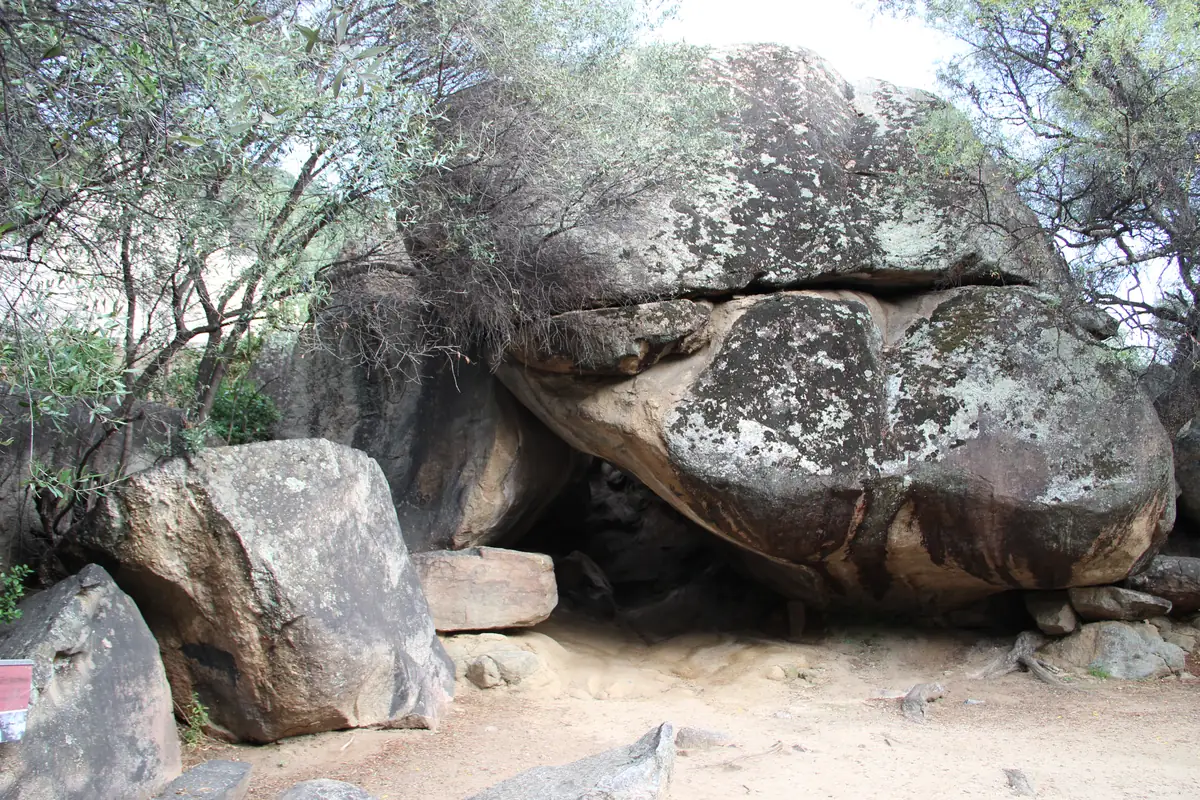
The cleanest plan is house first, table second. Spend the morning at the Maison Bonaparte, then walk along Rue Saint-Charles to number 4 for a lunch session and let the film tie together what you have just seen. If you prefer the evening, reverse it: spend the day on the gulf and finish with the dinner session, then visit the museum the next morning. Either way, add the Casone. On the Place d'Austerlitz a stepped granite pyramid carries a statue of Napoleon, inaugurated in 1938, and beside it lies the Grotte de Napoléon, a shelter of great granite boulders where, French Wikipedia says, legend has the young Napoleon taking refuge as a child. It is not the venue of the meal, but it completes the picture of the boy from Ajaccio.
What to book, and when
The museum is not something you book on this site; check its own information for opening days before you go. The Napoleon Cave is sold as dated sessions on Viator. On 28 November 2026 the earliest date in its booking calendar was 1 April 2027, and Viator noted that travellers book it about six weeks ahead on average, so spring and summer visitors should reserve early, especially for a lunch slot on a day they plan to spend in the old town. Bookings close two hours before each session. The ticket works on a phone or on paper, and confirmation is instant. If plans change, cancel no later than a day before the session and the refund is complete; inside the final day the booking is fixed.
The verdict
Pick the Napoleon Cave if you want the whole life story told simply, in your language, with a Corsican meal and drinks, in a single unhurried hour. Pick the Maison Bonaparte if you want to stand in the house where Napoleon was born and read its long and battered history in the rooms themselves. Pick both if you can: they share a street, they take very different kinds of attention, and together they make a better morning or afternoon than either does alone. Ajaccio has plenty more to fill the rest of the day, from the harbour under the citadel to boats for the Sanguinaires islands at sunset, but for the Napoleon story itself, Rue Saint-Charles is the place to start.
Frequently asked questions
Are the Napoleon Cave and Maison Bonaparte on the same street?
Yes. The listing gives the Napoleon Cave's address as 4 Rue Saint-Charles, and Wikipedia places the Maison Bonaparte on Rue Saint-Charles too.
Does the Napoleon Cave include food?
Yes. The complete package includes a muscat aperitif, the spuntinu meal, a drink of your choice and a coffee.
When did the Maison Bonaparte become a museum?
In 1967, when it was made a museum and declared a national museum, Wikipedia says.
Which should I do first?
The museum in the morning, then a lunch session at the Napoleon Cave, is the simplest order for a half day.
Sources